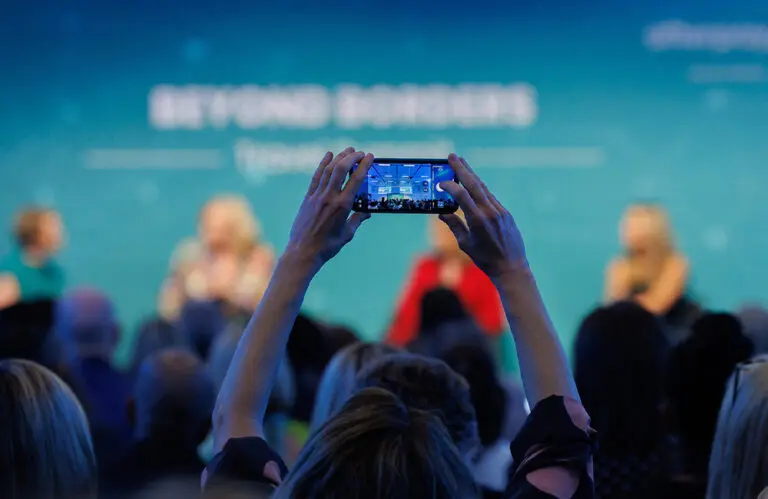



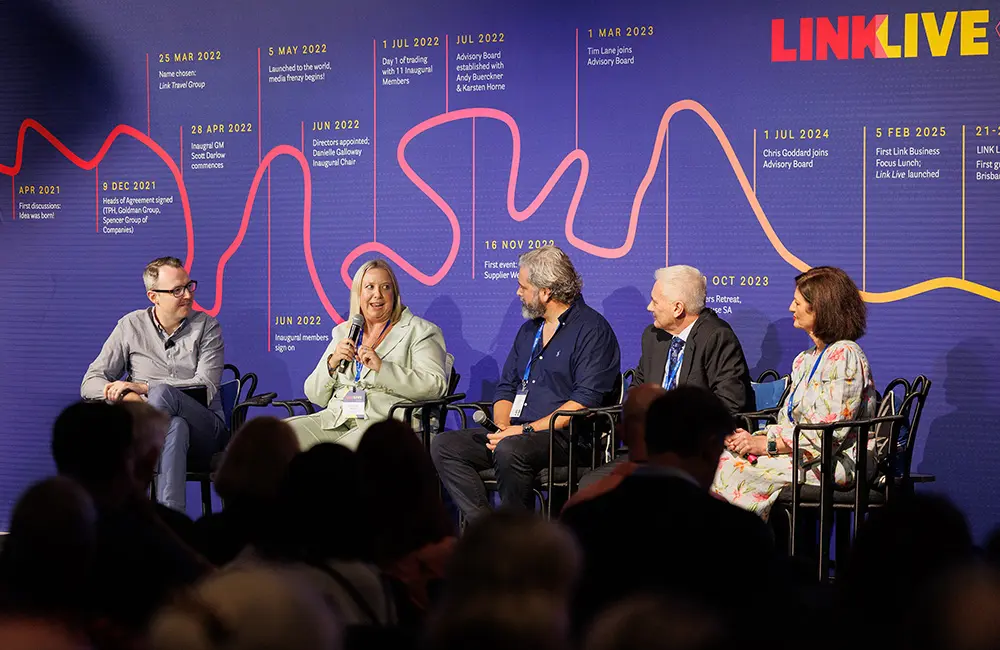
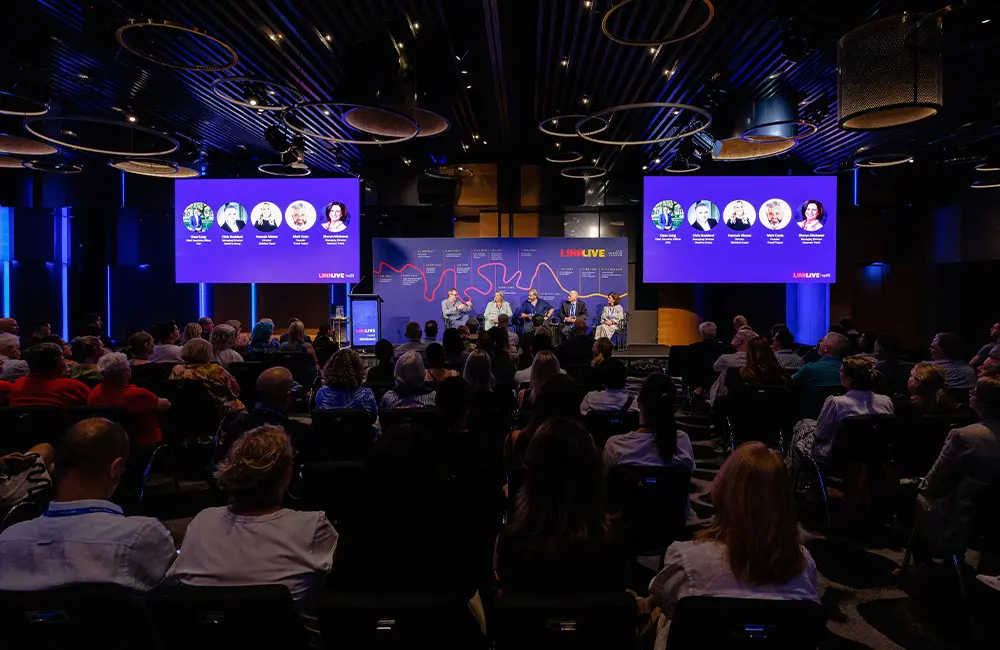
Link Travel Group’s inaugural conference, Link Live, was an invitation to “Reimagine Travel”. Nowhere was that more evident than in the “Redefining Value in Travel” panel, moderated by Dean Long, CEO of The Australian Travel Industry Association (ATIA).
Bringing together a diverse selection of Link Travel Group member leaders, Chris Goddard (The Maxim’s Group), Hannah Moore (Mobilise Travel), Matt Coyle (Travel Project), and Sharyn Kitchener (Mosman Travel and Mary Rossi Travel), the quick-fire 40-minute session delivered a refreshingly honest take on where value sits today and who is redefining it for tomorrow.
While the panel covered a wide range of topics, here are the key things we learned.
Value isn’t inherited. It’s created
Chris Goddard from The Maxim’s Group opened the conversation with an honesty only experience allows. “I need to dispel the rumour that I actually know what I’m doing,” he quipped.
“I started 37 years ago purely as a corporate TMC; that’s pretty much what I knew,” he said, explaining how he had to push beyond familiar territory to remain relevant. As time progressed, he said, “you’ve got to constantly look at your business and work out what is the best path forward,” and for him, “it was going to areas of travel that I had absolutely zero experience in and building on that.” That meant venturing into events, retail, consolidation and building an in-house IT department.
For Goddard, that stretch became the point. “Don’t be afraid… back yourself,” he said, adding that he was tired of clichés but still determined to “push the boat out” and “give it his best shot.”
The power of finding (and maintaining) your niche
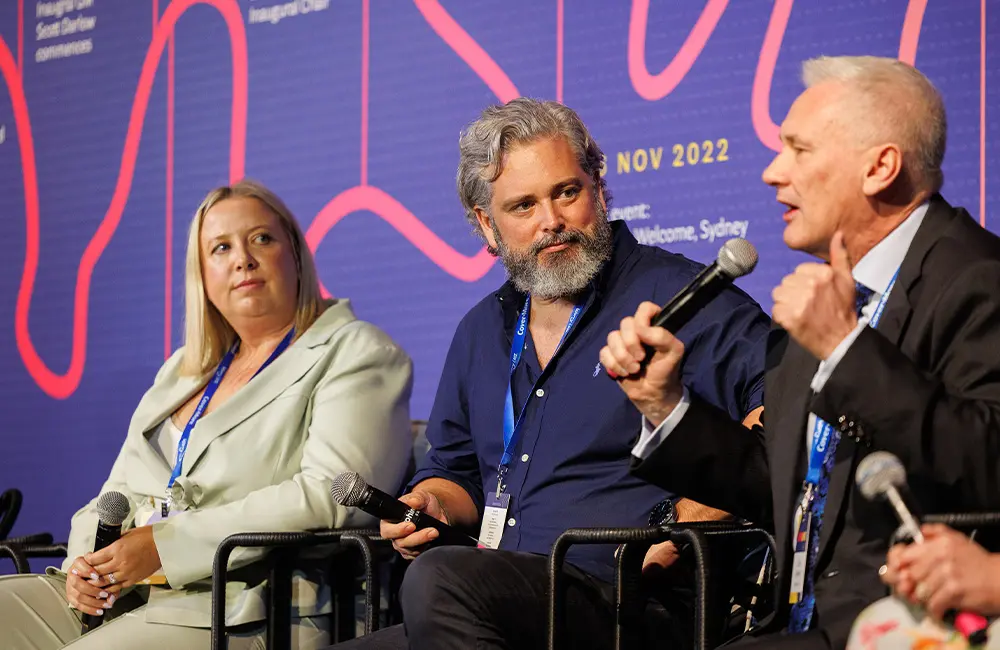
Hannah Moore demonstrated the exact opposite strategy and showed why it works. “Mobilise Travel is only in our fourth year, so we’re only young, and we are specialising in one field,” she said. “We’re not at the point yet to have a leisure brand or events. We are really focusing on what we’re good at, what we’re strong at, and we are really honing in on that niche and providing really specialised services to a very specialised industry.”
“We are a corporate TMC from Fremantle in Western Australia,” she said. We specialise in workforce logistics for the marine and oil and gas industry. Specifically, we do not engage in mining, as many people assume that anyone from WA does. We do ocean-based operations, vessel operations, rig movements, and helicopters, anything ocean-based that keeps that resources industry ticking over.”
That focus is paying off. “We have become the absolute experts in that industry,” she said. “All of our business now is referral. So it’s working, and others in that industry are coming to us.”
Advisors aren’t agents anymore. They’re architects
Travel Project founder Matt Coyle brought emotion into the conversation and showed why the shift from agent to advisor for him is no longer semantic. “If I go back six years, when we started, I actually struggled to understand what our product was,” he said. “I did feel like, almost like an insurance broker, that we were just matching our people with product… almost like a little bit of a leech, to be honest.”
Over time, that changed. “I really understood the importance of what we do, and not being an agent, but more an advisor,” he said. “I love my analogies,” he added, before switching to one that stuck with the room: “being an architect designing a home. You may be working with one product in Colorbond, but you don’t build a Colorbond; you build a home.” It’s all about “understanding the customer and bringing all of the different parts together to actually make it something really unique.”
With a tagline of “Travel outside the algorithm with us”, Coyle explained how focusing on the anticipation stage has become Travel Project’s point of difference.
“Travel Project’s really focusing on the anticipation stage of a holiday. That’s where our product lies,” he said. “If you look at the unboxing videos that are all over YouTube, the anticipation of opening up something new is everywhere, and everybody loves that. And that’s where our product lies, in anticipation of a holiday, the anticipation of a unique experience.”
Service fees weren’t a trend. They were overdue
With over four decades of perspective, Mosman Travel and Mary Rossi Travel’s Sharyn Kitchener brought grounded clarity to the ongoing topic of service fees. “We really grew up in COVID and realised how hard life was and how passionate we were in our industry and how vital we are,” she said. “We realised that we needed to start to get clever and put our money where our mouth was, and to really focus on our service fees.”
“When we came out of COVID, it was like a tsunami hitting us. We were all so busy,” she said. “We just started from day one and explained the situation and said that, without you helping or paying fees, we can’t survive any longer. We’ve lost a lot of commissions from the airlines. We’ve lost a lot of money over COVID, and it was time to be professional.”
Why hadn’t service fees stuck earlier, did she think?
Before COVID, she said, it was a “very competitive space,” with “price beats everywhere” and “so many OTAs that were just dropping prices by 15-20 dollars,” and because “margins were very healthy, I think many in the leisure space didn’t want to put up a barrier to potentially lose a booking.”
Kitchener also reminded the room where the real value shows up. When clients say they can book their own airfare, “I say, well, you can book it yourself, but if there’s a schedule change or the flight is cancelled, I can’t dig you out of that hole because I don’t own that booking,” she said. “You’re going to be on your holiday, and you’re going to spend five hours on hold to an airline to try and fix that problem.”
In contrast, “when there is a disaster in the world… we can shine,” she said, recalling how her team “go into bat for their clients” and help them navigate what they can’t do on their own. “For that small booking fee that they’re paying, it’s the biggest value-added service we offer.”
What suppliers are doing right (and what advisors want more of)
When Long pushed the panel on what suppliers are doing well, the answers were mixed but aligned.
Goddard pointed to efficiency and productivity. Referring to Qantas Agency Connect (QAC), he said, “What they’ve done with QAC and the website and the efficiencies now, particularly [in] corporate improves efficiency within my business.” “Efficiency and productivity are what it’s all about,” he added.
Kitchener emphasised relationships. “Relationships, definitely, and having a connection with the hotels directly is very important to our business and our philosophy,” she said. With high-end clients who “pivot on a daily basis,” those direct ties matter. “Having those direct relationships with those hotels, they will help me waive those cancellation fees. They’ll change the suite. They’ll do anything they can to help me help our mutual client achieve what they need.”
Moore highlighted relevance and understanding. Thanking the airline partners in the room, she said, “they refer business to us,” and, crucially, “they understand what we do.” “If they come across a client that would be a great fit for us, we’re at the front of their mind to think, you know what, this client would be great for Mobilise. And so I feel like that is just invaluable. It might not always go anywhere, but it’s a referral that they send our way.”
Closing out the session, Coyle focused on creativity and shared the importance of taking calculated risks. “Thinking outside the box to work together and reimagine how we can do things,” he said, describing a marketing opportunity where a supplier sent an influencer from Travel Project. The result? “Not only did we promote the product, but when they came home, we booked around $200,000 worth of the product,” he said. “Just thinking outside the box and giving it a shot, that’s what I like.”
Read our Link Live event wrap here and our exclusive interview with The Link Travel Group Board here.
Link Travel Group‘s inaugural network conference, Link Live, was held from November 20 to 23 at the W Brisbane. The highly anticipated, sold-out event brought together 180 delegates for three days of insights, connection and celebration.