


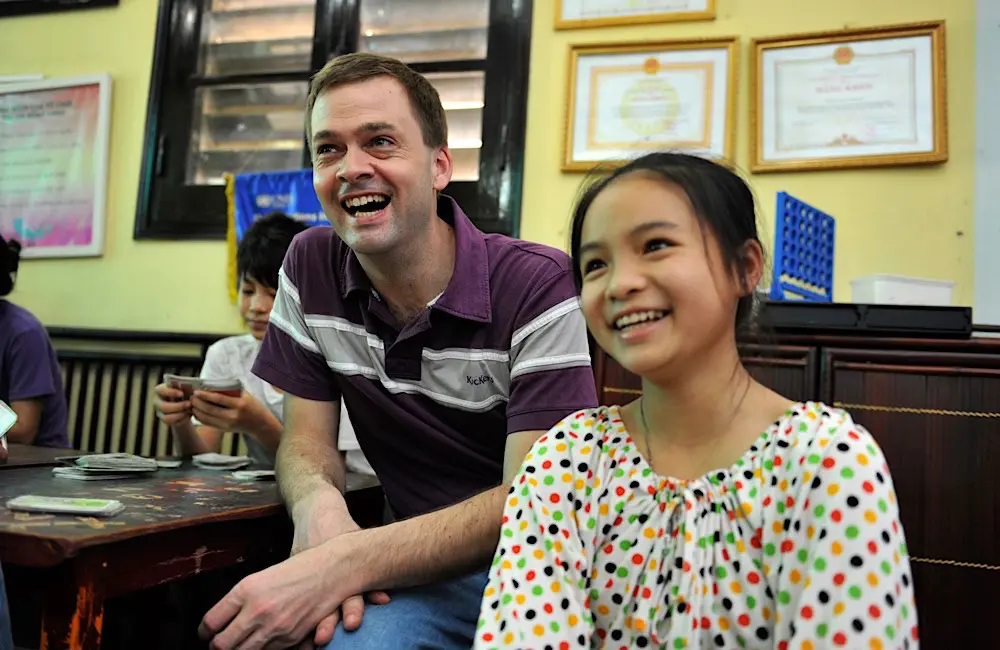
The boy was 13, half-heartedly selling flowers in the tourist district of Ho Chi Minh City. Michael Brosowski, who was only in the city for a few days, visiting from his new home in Hanoi, knew something wasn’t right straight away. “He was so, so tired and just wanted to go home.”
The boy was from a village in central Vietnam and had been told he was going to the city to learn a trade so that he could send money home. Instead, he was put to work on the street and his family had no idea where he was.
Michael spoke with him, then phoned Hanoi, where one of Blue Dragon’s volunteers helped fill the gaps in translation. They got the boy home. Later, they went to the village and found other children had been taken too. “Well, what do we do?” Michael asked. “We better go and find those kids.”
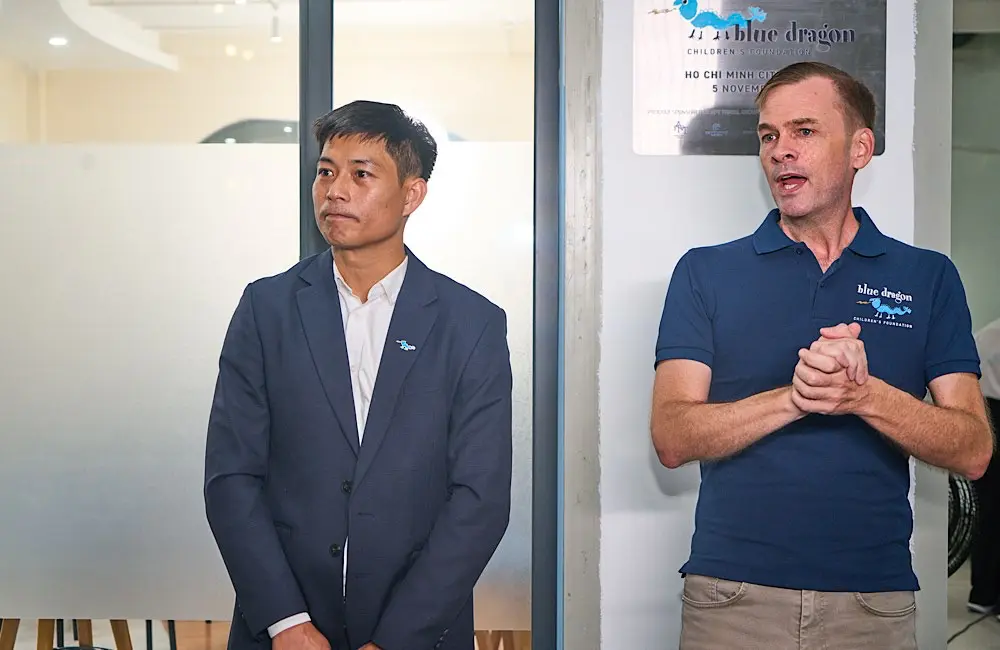
Michael Brosowski is the founder and strategic director of Blue Dragon Children’s Foundation, a Vietnam-based organisation working to end human trafficking. At a grassroots level, it rescues children and young people from trafficking, reunites them with their families, and supports them through schooling, legal advocacy and long-term care.
Built to keep going
Michael was born in the Sydney suburb of Botany, back when it was still a heavily industrial suburb, to parents who both worked in factories. Then, not long before his teens, they left Sydney for the New England region, buying a block “with nothing on it except hills and rocks” where the closest town was a half hour away with a booming population of about 400. It was the era of A Country Practice and his parents had bought into the dream of self-sufficiency. “Of course,” he says, “it was very, very different to that.”
His father had come from Dortmund in Germany. He had left school at 14, worked in a coal mine, arrived in Australia at 18 and, once the family moved north, set about building a house with the same matter-of-fact resolve he seemed to bring to everything else. Michael remembers helping dig out the cellar: about fourteen feet down, cut by hand, father and son. Then the slab over the top. Then the house itself, built from books, magazines, trial and error, and the stubborn assumption that not knowing how was not a permanent condition.
Michael says he inherited none of the practical skill. “If you ask me to put a nail in the wall, I’ll demolish the whole building,” he jokes. What he did inherit was something more durable.
His father, he says, “was a very passive, quiet man who just worked out how to do things and just kept on going”.
“’Just keep going,’ he’d say. ‘Just keep going, no matter what happens’.”
The first thread
The novelty of the self-sufficient dream wore thin pretty quickly. Michael remembers living in a caravan with no electricity, getting water from the creek. A drop toilet. He remembers the distance to school, and the particular loneliness that comes with struggle.
But you didn’t stop because things were difficult or the plan had become harder than the fantasy. “It might be really terrible and difficult now,” he says, “but you just keep going. Giving up isn’t an option.”
Michael occasionally looks up his old house. It’s still standing strong.
If those years in rural New South Wales feel, in memory, almost bleached out, not empty but overexposed, then the first real colour came from Shirley McCoombe, his English teacher. She taught him for four years at a tiny central school and was, he says, “the one person who got me”. She fed his imagination with books that travelled farther than he could, with language that suggested other lives were possible, with the quiet insistence that there was more beyond the edges of what he knew.
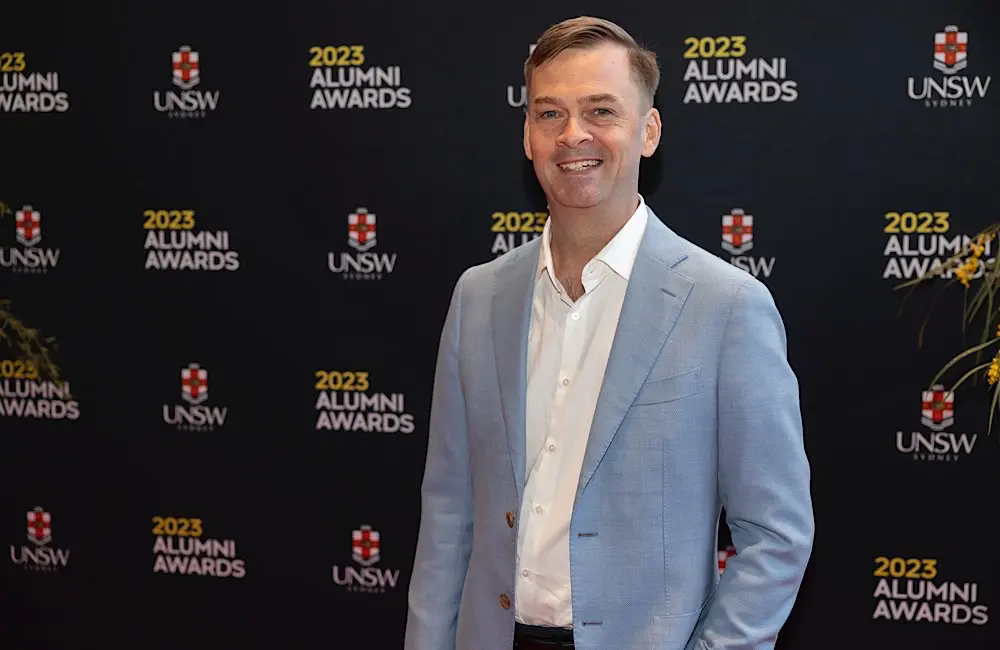
A few years later, in Inverell’s senior high school, Michael struck up a friendship with a group of kids, refugees from Vietnam who had arrived via a camp in Malaysia.
“They told these stories of pirates, and rape, refugee camps and all these terrible things.”
Michael, whose world had been “very insular, very white”, volunteered to teach them English in his free periods. “It just opened my eyes to the whole world,” he says. “I could see how valuable education was for these kids, how it really could change their life.”
Love at first sight
Michael followed that first bright thread into teaching, then into the kind of emptiness that can be hardest to explain because nothing is visibly wrong. He had wanted to be a teacher. He became one. He ended up teaching at a good school full of good people, but you get the impression that that was all just filler.
Around that time, he travelled overseas for the first time. Thailand first. Then Vietnam. Alone, with a Lonely Planet, without a word of Vietnamese, wanting what he describes as “a little bit of culture shock”, though even now he is not sure why. What he does know is what happened when he arrived. “I loved it,” he says. “From arriving, I loved it.”
Learning to see
In The Wizard of Oz, Kansas was shot in sepia, Oz in the new Technicolor. When Dorothy’s door opens to the new world, everything is just more. That’s the sensation of hearing Michael talk about Vietnam after Australia. A life that had felt overexposed, bleached by duty and distance, suddenly turns saturated. He returned to Vietnam again and again.
Eventually, the logic became impossible to ignore. “I loved being there. When I wasn’t in Vietnam, I was thinking about going back.”
In March 2002, after completing a Master of Education, he bought a one-way ticket to Vietnam. “I couldn’t have been happier.”
When everything changed
Vietnam gave him friendship, language, purpose and what he calls a sense of community he now misses in Australia. He talks about the country’s ‘yin and yang’, the opposites it holds in place without apology. He talks about village life, about people looking out for one another, about the warmth extended to a foreigner who is at least trying.
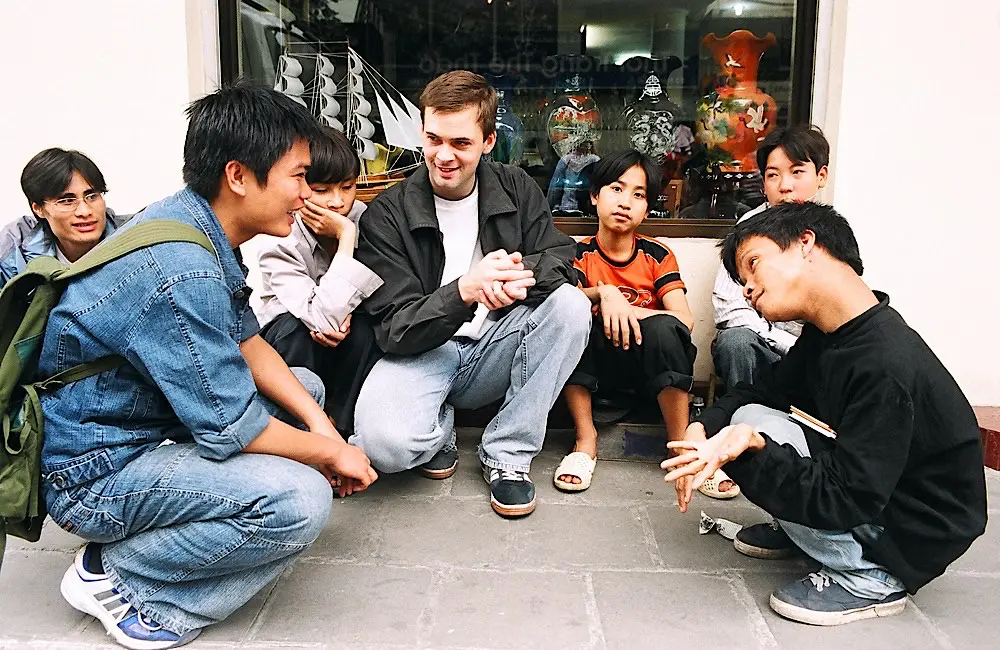
He also talks about Hanoi in late 2002, when he was transferred there by the university he was working for and initially not connecting with the city as he had with Ho Chi Minh. He was living in a hotel in the Old Quarter. There were street kids everywhere. He began speaking to them, buying a meal here and there, trading English for Vietnamese, doing what came naturally to him, which was not intervention yet, only attention.
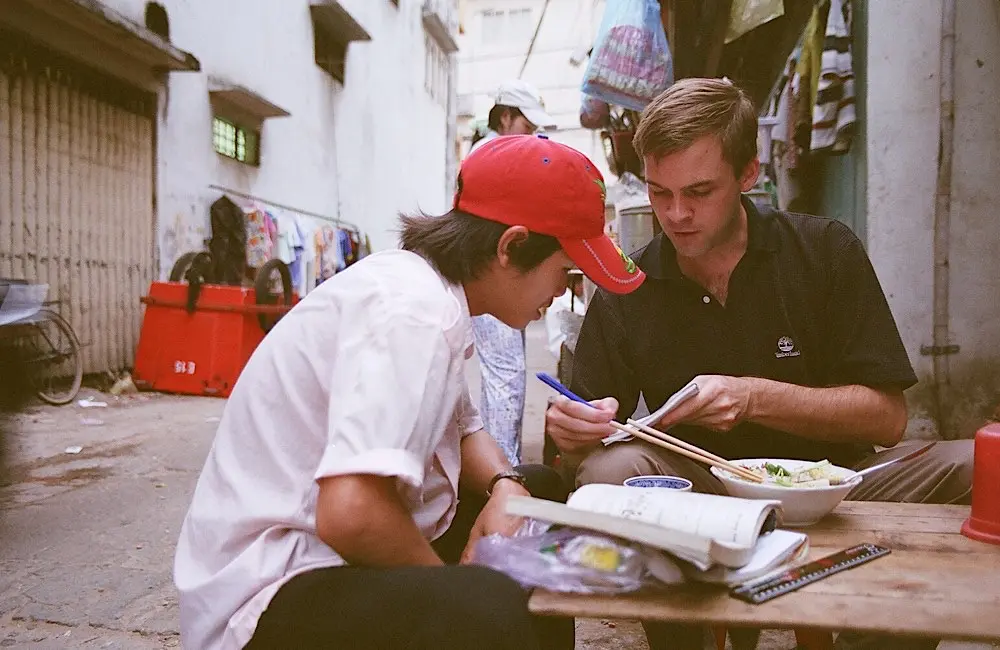
“I didn’t like having kids shine my shoes,” he says, opting instead to talk, to help. The conversations drew him back to those refugee students at school, to “young people doing it really tough, who just really wanted to learn”.
Then his students at the university asked if they could join him.
Together, they met the children. They met their families. They learned who needed what. A kid wanted vocational training. A mother needed a doctor. One child needed more than money, another less than pity. “So it went from just being sort of almost spontaneous conversations on the street to just a little bit more structure and thought,” he says. “And it worked.”
It is one of the striking things about him, the way he resists the tidy hero version of his own story. He is quick to admit what he did not know. Quick to laugh at his softness. “I was just getting ripped off blind,” he says of those early days, handing money to children because they told him they needed school fees. His students, he says, were sterner than he was. Between them, they found a way through.
By then, he had already followed the thread too far to let go of it. Government officials began asking who they were and where their permission was. Michael, never imagining he might need permission to organise a soccer game or an English class, found himself facing a choice. Stop, or build something that could stand.
“We went looking to see who else might fill that gap,” he says. “And it just kept coming back to: actually, it’s us.”
Building Blue Dragon
Blue Dragon was not born out of certainty. It was built the way his father built the house. One thing first, then the next thing, then the next. Borrowed knowledge. Improvisation. Long days. Principles strong enough to hold when there was no manual for what came after.
Michael says Blue Dragon still encounters situations every week that nobody has seen before. The answer cannot always be a set of steps. “You have to come back more to principles,” he says. “When you face this new situation, when you’re in this crisis, when you don’t know what to do, what are your guiding principles?”
That feels especially true when the work moves from street outreach into trafficking cases, where almost nothing presents itself cleanly. Outreach taught them how to listen for what was not being said, how to see through layers, how to accept that children might not tell the truth because the truth is too dangerous to hand over quickly, Michael tells Karryon.
It taught them, above all, how to go looking. By the time that 13-year-old flower seller crossed his path in Ho Chi Minh City, Michael and Blue Dragon already had the instincts to recognise that a child so far from home with no schooling and no freedom was unlikely to be carrying only one story. They got him home. Then they went back for the others.
They had other stories. Some not so easy to tell. Or hear.
Michael, characteristically, does not romanticise any of this. He talks instead about holding contradiction. “I must accept some terrible things that I see and that are there,” he says, “and at the same time, I don’t accept them, and I’m trying to change them, but I have to carry both of those ideas together.”
A lesson for travellers
Travel puts people close to human crisis without necessarily giving them the language to meet it. A child begging at an intersection. A child selling souvenirs late at night. A child offering services no child should have to offer. The tourist sees a fragment and is left to improvise a moral response on the spot. Sometimes that means handing over money. Sometimes it means looking away.
Michael is careful here. He says he understands why a traveller might give. He would not condemn the impulse. But he also knows what happens when compassion stops at the point of encounter. The child is still there tomorrow. The machinery around them is still working. The story goes on.
What he urges instead is preparation, curiosity, responsibility. Learn before you travel. Ask operators what organisations are trusted locally. Know who is doing the work after the tourists have moved on. Support them.
The Blue Dragon
I forgot to ask Michael where the name Blue Dragon came from. I’d read some accounts that it had something to do with the big blue Australian sky, which I do think Michael misses. The dragon symbolises the children’s bravery and resilience. Later, when attempting to Google the foundation, I instead happen across a sea creature called a blue dragon: a small electric-blue slug adrift on ocean currents, feeding on venomous prey and storing the sting for its own defence. It survives by learning how to carry danger without being consumed by it. But it’s also vulnerable to shifts in the world around it, especially when those shifts come from forces too large for a single creature to command.
Wars hit your purse strings. When things get hard, people have to cut back and that means support to organisations such as Blue Dragon can get cut too.
Support their work directly via The Intrepid Foundation. Donations go to Blue Dragon’s frontline rescues, legal support and long-term care, turning a passing moment into something that lasts.
These days, Michael no longer pretends to be the best person in the room at Blue Dragon. He says quite happily that he is not. He goes out on outreach occasionally and finds himself watching younger staff, some of them former street kids themselves, move with an instinct he no longer has.
He tells a story about being out one night with a staff member he once helped as a teenager. Two little boys appeared from the bushes. Michael was still taking in the scene when the younger man had already crossed to them, talking, earning trust, working out injuries, hunger, immediate need. “I was contributing nothing to this process,” he says, half amused and wholly proud. Blue Dragon now, he says, lives beyond him.
“All I have wanted to do here is help kids, to make things a bit better,” he says. “And now that’s happening even if I’m not there.”
There is nothing flashy in it. No self-canonisation. No founder mythology. Just the quiet miracle of something built well enough to outgrow the man who started it.
And perhaps that is the real colour change. Not the first trip. Not the first child. Not even the moment he understood what the trafficking crisis was asking of him. Perhaps it is this: the movement from seeing suffering as something too large for one passer-by to hold, to building, over years, an ecosystem strong enough to answer when the next child appears with flowers in his hands and fatigue in his face and a story that does not sit right.
Not everyone can do what Michael Brosowski did.
But travellers can do more than look away. They can learn before they land. They can ask harder questions. They can support the organisations already doing the work. They can refuse the comforting lie that complexity excuses distance.
Blue Dragon didn’t start as a solution. It started with one child, then another, then a decision not to stop.
That’s how this work holds. Not because the problem is small enough to solve, but because it’s met anyway.
And it keeps being met.
“Just keep going,” his dad used to say. “Just keep going, no matter what happens.”
Child by child.
Until you change the world.