



AVG Travels has entered liquidation, leaving customers chasing refunds, missed flights and the wreckage of holidays they believed were safely booked. It has also exposed the harder question now facing travellers and the trade: when a booking looks legitimate, which protections actually count?
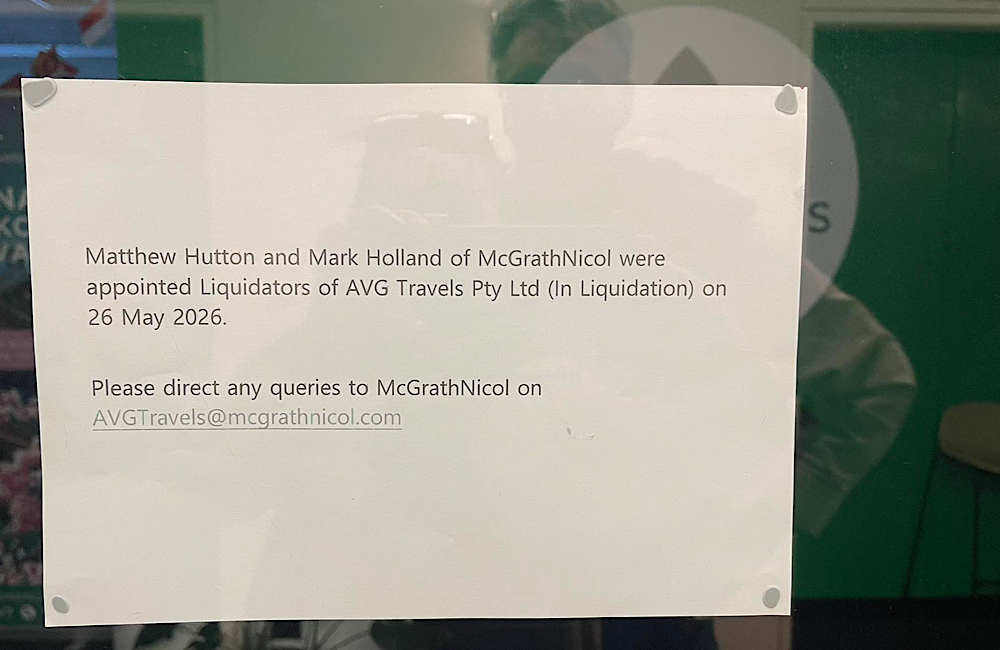
A notice published across AVG Travels’ website and taped to the door of the company’s Melbourne office advises that Matthew Hutton and Mark Holland of McGrathNicol were appointed liquidators of AVG Travels Pty Ltd on 26 May 2026, with all queries directed to the insolvency firm.
The appointment followed weeks of customer alarm over tours that were cancelled, changed or placed “under review” close to departure.
One customer, posting in an AVG Travels customer group on 22 May, said they were stuck at Shanghai airport.
“Apparently AVG made the booking but didn’t pay for the ticket therefore no tickets were issued for us,” the customer wrote.
“Our local guide contacted AVG and they suggest we pay the ticket ourselves first, that’s $1000 AUD per person. AVG will reimburse us back. Is this reliable?”
Another customer said they had booked a 24-day Spain, Portugal and Morocco trip for September and had been paying it off in instalments for 12 months.
“They took the last instalment of $7,800 five days ago,” the customer wrote.
“$20,000 for the two of us.”
When everything looks legitimate
The AVG collapse shows travellers need a clearer way to tell meaningful accreditation from the wider set of trust signals that can make a travel business look protected.
Booking through an ATIA-accredited travel business is already being treated as the key warning from the collapse. It is an important one, but only if travellers understand how to check it, what it means and why other signs of legitimacy can still leave them exposed.
Travellers are not choosing between a professional travel advisor and a bloke with a Gmail address. They are looking at polished travel websites with secure payment icons, office addresses, ABNs, supplier names, review stars, testimonials, “flexible” terms, instalment options, savings claims and package pages that look like the rest of the online travel market.
AVG’s website described the company as proudly Australian-owned and said it had taken more than 200,000 travellers around the world. Customers could find the familiar signals of a functioning travel business.
What they could not find was current ATIA accreditation.
A business can look established without meeting recognised industry standards. Travellers need to know which accreditation is current, where to verify it, and what protection sits behind the signs they are being asked to trust.
ATIA says accreditation must be prioritised
Australian Travel Industry Association CEO Dean Long said the collapse shows what can happen when accreditation is treated as optional.

“The collapse of AVG Tours is a direct consequence of the gaps that exist when accreditation is not prioritised,” Long said.
“If travel businesses are not ATIA-accredited or are choosing to work with suppliers and partners who are not accredited, they are creating the conditions for operators like this to exist and grow.
“That is a risk to your business. It is a risk to your customers. And ultimately, it damages confidence in the broader industry.
“ATIA accreditation exists for a reason. Businesses that do not prioritise it, or actively work around it, share responsibility for the space that unaccredited operators fill.”
The advisor case is now sharper
Blue Agave Travel, an ATIA-accredited agency and Envoyage member, posted after the liquidation announcement that AVG was not ATIA-accredited and that the collapse was “a timely reminder of why it matters who you book your travel with”.
“When you choose an ATIA-accredited travel agency, you’re booking with a business that meets strict industry standards for professionalism, transparency, and financial compliance,” the agency wrote.
The agency said travel is “one of life’s biggest investments” and that support from an experienced, accredited advisor can make a major difference when plans change unexpectedly.
The value of a travel advisor is knowing which suppliers to trust, when to push for documentation, how to confirm the booking chain, what questions to ask before money moves and how to respond when something starts to go wrong.
Accreditation gives travellers one clearer signal. A good advisor gives them someone who can interpret the rest.
The problem with cheap holiday logic
The AVG collapse will inevitably trigger warnings about deals that look too good to be true.
But Australian travellers have been trained to shop through savings claims, low deposits, payment plans, limited-time offers, comparison pages and packaged value. The broader travel market has normalised big discounts and urgency-led retail.
The sales cues look familiar. The protections are less visible.
Low deposits make the first step easier. Instalments make a large holiday feel manageable. A professional site makes the booking feel safe. A real office makes the company feel accountable.
The protection may still be thin.
What travellers should actually look for
The key questions need to come before payment.
Is the travel business currently ATIA-accredited? Is the advisor using accredited partners? Has the airline ticket been issued? Has the supplier been paid? Is client money being held, passed on or exposed? What does the insurance policy exclude? What happens if the company collecting the money fails?
A logo on a website is not enough. Travellers need to check whether the business is currently ATIA accredited through ATIA’s own channels, not through a badge, old reference, screenshot or claim on a booking page.
AVG Travels has collapsed. Its customers are now left testing every promise, policy and payment pathway after the money has gone.
The travel industry cannot afford to let accreditation be treated as a decorative badge. It has to be the line between businesses that meet recognised standards and operators allowed to trade on the same visual language of trust.