





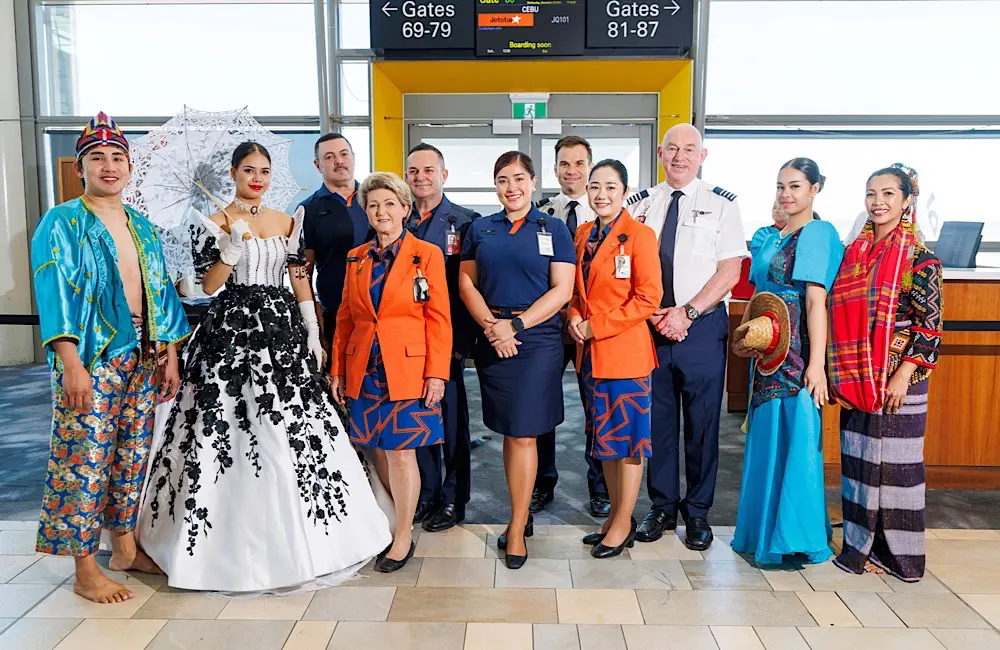
Australia’s only nonstop direct link from Brisbane to Cebu went live this week, a clean pipeline into a corridor that has been deepening on price tension, diaspora ties and rising outbound appetite across Queensland.
The service is operated by A321LR aircraft and timed squarely against peak movement, dropping more than 37,000 seats into a market that previously required longer connections.
For Queensland, it’s a one‑hop access point into the Philippines and a signal that Jetstar is willing to experiment where mid‑haul economics and VFR behaviour intersect.
What’s changed?
The Philippines piece is accelerating. Two new routes within weeks now total more than 109,000 annualised low‑fare seats into the market. Cebu slots in alongside Jetstar’s Perth–Manila offering as the airline leans into VFR resilience and demand from Australians looking for fast Asia links.
The mid‑haul economics stack. A321LR range and fuel efficiency pull Cebu into Brisbane’s orbit, supporting the move into a corridor where direct links have been limited. The fleet program is central: newer aircraft tilt the balance from pure frequency lifting toward new map points.
Stephanie Tully said the fleet uplift is allowing the group to widen access and stimulate demand.
“As demand for international travel continues to rise, our expanding fleet is allowing us to deliver more low fares to new destinations,” she said.
Translated commercially: fleet is being deployed into markets where price elasticity can be tested.
Why choose this link?
Cebu operates as a multi‑directional gateway. Strong inter‑island connections, VFR volume and tight cultural ties make it less speculative than it first appears. Seasonal scheduling gives Jetstar a read on demand signals, price sensitivity, shoulder‑month loading and onward travel behaviour.

Queensland’s Filipino community is a material driver. Family travel patterns are sticky, less weekend‑dependent and more resilient on fare shifts. If VFR load holds through February shoulder periods, the airline has headroom to keep scaling or to revisit seasonality.
Competitive and corridor dynamics
Philippine Airlines and Qantas continue to centre Manila. Cebu Pacific leans into Sydney. Jetstar has gone for a different target by planting volume into Cebu and giving Queensland an alternative origin for Filipino and Australian travellers.
Pressure tends to sharpen when a corridor gains a new direct link. Price becomes a live lever. With introductory fares starting at $249 one‑way, the carrier has telegraphed intent to stimulate rather than chase yield from day one. If the route holds profitable loads at that level, higher floors can be tested later.
Brisbane Airport CEO Gert‑Jan de Graaff said the route becomes the airport’s 35th international destination and strengthens Queensland’s connection into the Philippines. In trade terms, that unlocks more efficient flows for business, education, conferences and higher‑spend inbound leisure.
De Graaff framed the new link as strengthening Queensland’s connection with the Philippines and landing ahead of a heavy holiday travel period.
“[The new route] offers Queenslanders easier access to one of Asia’s most breathtaking island destinations, from a canyoneering adventure in Kawasan Falls, witnessing the world-famous sardine run in Moalboal or enjoying the spectacular sunsets the Philippines are renowned for,” he said.
Peak placement
The link has launched directly into the Christmas surge. Jetstar expects more than two million passengers to travel to and from Queensland through December and January. High‑volume periods compress margins, stress airport operations and elevate ancillary and operational performance metrics.
Dropping a new Asia link into the peak period gives the airline live data on demand momentum, day‑of‑week resilience and price elasticity. If New Year loads sustain after January’s frequency uplift, the carrier can model the corridor with greater confidence.
Fleet strategy and the year ahead
A321LR and A320neo aircraft widen Jetstar’s mid‑range reach, pushing Cebu into range and enabling the carrier to place capacity in markets where direct links have been thin.
The route also sits inside a 2025 map build that includes Rarotonga and Queenstown. The common thread: outbound interest in short‑haul Asia–Pacific leisure and room for low‑fare networks to deepen.
Brisbane now hosts seven international Jetstar routes as the airport–airline agreement from mid‑2023 continues to translate into broader network shape and higher seat volume. In eighteen months, Jetstar has moved from Brisbane’s seventh‑largest international operator to second.
From here, the metric is yield. With Cebu on the board, Jetstar can watch diaspora load anchors, fare tolerance and whether VFR plus leisure segments widen once the nonstop link beds in.
KARRYON UNPACKS: The Brisbane link hands Jetstar a live corridor test on mid‑haul Asia economics, diaspora resilience and price behaviour through peak and shoulder cycles.