



Ordering a ‘crah-sont’ in Paris is forgivable. Booking a holiday to somewhere you can’t pronounce and then saying it loudly at a dinner party is a lifestyle choice.
Travel and mispronunciation are long-term companions. The moment we see a cluster of unfamiliar vowels, we do what Australians do best: flatten it. Stretch it. Add an R. Remove a syllable. Or three.
Most trips require us to navigate words shaped by entirely different sound systems and then pretend English rules still apply. We spot familiar letters and assume they’ll behave. They do not. Melbourne can’t even agree on Reservoir (RES-uh-vor, apparently), and that’s before we’ve left the country. Sometimes we’re close. Often, we are spectacularly certain and completely wrong.
Some names are anglicised. Others preserve pronunciation from their source language. Others are words Australians have simply agreed, en masse, to say incorrectly for decades.
So here’s a guide to pronouncing some of the more commonly mispronounced places and terms you may encounter when travelling. And remember, if you’re lucky enough to be sitting at the pointy end of the plane, the pronunciation test begins before the wheels leave the runway. The Champagne trolley is not the place to freelance.
Veuve Clicquot is vuv kli-KOH. ‘Veuve’ rhymes with love. ‘Clicquot’ rhymes with go. It is, essentially, love and go. Taittinger is TET-an-zhay, not tay-ting-er, Bollinger softens to BOLL-in-zhay. Dom Pérignon is dom peh-ree-NYON. And Moët? It’s mo-ETT. The T is pronounced. It has always been pronounced. If you say ‘Moay’, you’re not alone, but you are wrong.
Travel dishes
Phở – fuh (often said as ‘foe’ and this dish is not the enemy)
Bruschetta – broo-SKET-ta (when said correctly, can be accompanied by a sense of moral superiority)
Paella – pah-EH-ya (in Spanish, the double L makes a Y sound. In Spain it’s closer to pah-EH-lya; in much of Latin America, pah-EH-ya)
Ceviche – seh-VEE-chay (get this right and you’ll almost be able to answer any follow up questions from the waitstaff)
Gnocchi – NYO-kee (The G is silent. It knows what it did)
Açaí – ah-sah-EE (often said as ‘ack-eye’, usually with enormous confidence)
Gyro – YEE-ro (not ‘jy-ro’ – even in the United States)
Tagliatelle – tal-yah-TELL-eh (practice before ordering)
Niçoise – nee-SWAH (often said as ‘nick-oise’, which feels aggressive)
Travel destinations
Ibiza – ee-BEE-tha (pronounced correctly right up until about midnight)
Reykjavík – RAYK-yah-veek (often said as ‘rye-ka-vik’. Say it once correctly and move on.)
Versailles – ver-SIGH (often said as ‘ver-sales’, which sounds like a seasonal promotion)
Edinburgh – ED-in-bruh (Cc’mon bruh)
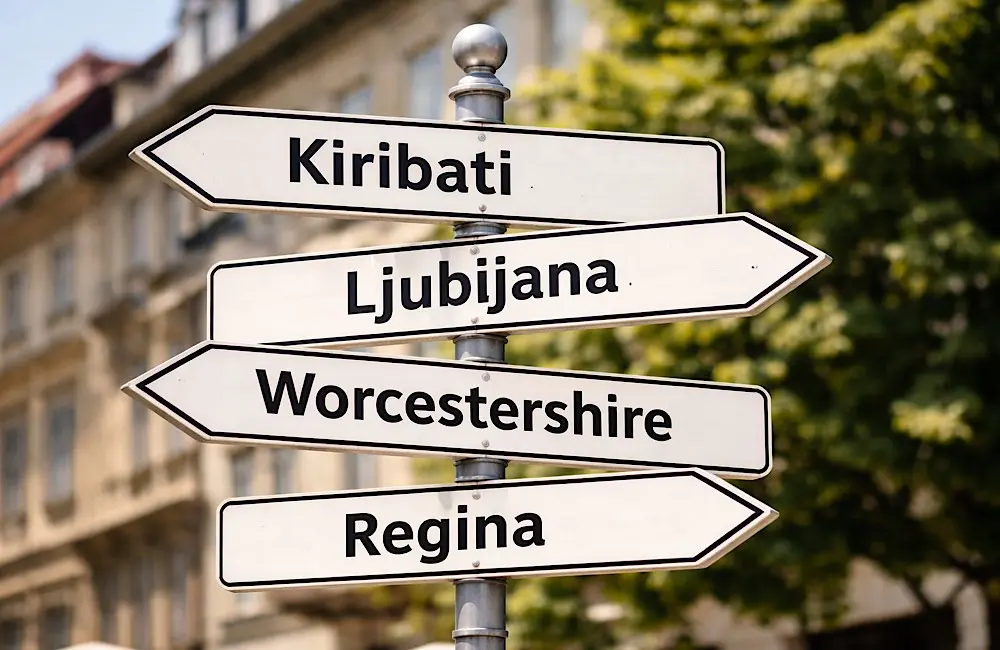
Kiribati – KEER-ih-bas (often said as ‘kir-ee-bah-tee’, because English sees letters and gets ideas)
Maldives – MOL-deevz (Mal does not dive in The MOL-deevs)
Caribbean – ca-rib-BEE-an is generally considered closer to the indigenous root “Carib” (KAR-ib) and often preferred for the geographic region
Regina (Canada) – ri-JY-nuh (Yes, it rhymes with a part of the female anatomy)
Cannes – KAN (often said as ‘cans’, which is obvs how we say Cairns)
Nice – NEESS (often said as ‘nice’, which is accurate but not helpful)
Ljubljana – lyoo-BLYAH-nah (often said as anything else)
Worcestershire – WUSS-ter-sheer (locals will accept Woorshhhusomething something)
Köln – kurln (in English, it’s usually pronounced kuh-LOHNz)
La Jolla – luh-HOY-uh (often said as ‘la joll-uh’, which is not even close)