


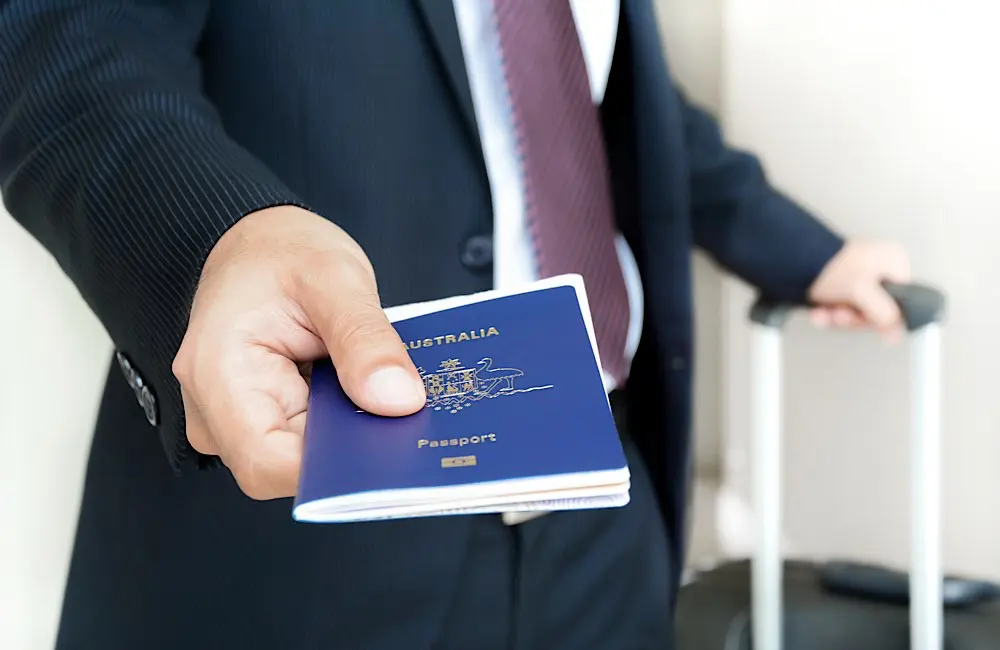
Australia’s passport remains one of the world’s strongest, but a new global ranking suggests it’s becoming harder to take that status for granted.
For decades, passports from countries like Australia, the UK, Canada and the United States were considered untouchable. Not anymore. The latest Global Passport Index shows Australia’s passport has fallen 10 places since 2021, joining a broader decline across the Anglosphere as visa reciprocity, diplomacy and geopolitics increasingly reshape global mobility.
The 2026 Index ranks passports across 197 countries and territories using three measures: Enhanced Mobility, Investment and Quality of Living. While Australia remains among the world’s stronger overall, it was one of four Anglosphere nations to lose ground over the past five years. Ireland was the only country in the group to improve its standing.
Australia’s decline is part of a bigger shift
The report found Australia has dropped 10 places in the overall rankings since 2021, alongside declines for Canada (down 11 places), New Zealand (down 15) and the United States, which has fallen from first place globally in 2021 to 12th in 2026.
Researchers say the trend reflects a changing global approach to visa access.
For decades, many Anglosphere countries enjoyed broad visa-free access around the world while maintaining relatively restrictive entry requirements of their own. Increasingly, countries are responding with reciprocal visa policies, meaning passport strength is becoming more closely tied to diplomacy and international relationships than historical influence.
“For decades, the Anglosphere passports were treated as fixed inheritance,” said Dr Laura Madrid, Lead Researcher at Global Citizen Solutions.
“Our data says it is closer to an asset that can lose value or gain it responsive to policy, to diplomacy, and to how a country chooses to treat others.”
Brexit still shapes Britain’s travel ease
Perhaps the clearest example of that shift is the United Kingdom.
A decade after the Brexit referendum, the UK remains eighth overall in the Index, but its mobility ranking sits at just 30th. That’s a gap of 22 places between its overall strength and travel freedom, the largest among the Western European and Anglosphere passports examined.
The report argues this reflects the lasting impact of losing automatic freedom of movement across the European Union.
Ireland, meanwhile, ranked seventh overall for the second consecutive year.
Irish passport holders retain unrestricted access to live and work throughout the European Union while also benefiting from the Common Travel Area with the UK, allowing them to live, work, study and vote in either country without visas or time limits.
“The United Kingdom passport held firm in the global top ten,” said Patricia Casaburi, CEO of Global Citizen Solutions.
“Yet for a passport of such standing, its mobility rank is conspicuously modest, around 30th, well adrift of the elite tier it otherwise occupies.
“That gap is the quiet signature of Brexit.”
Europe dominates
Europe continued its dominance of the rankings, claiming nine of the world’s top 10 passports.
Sweden topped the 2026 index ahead of Switzerland and Finland, with Singapore the only non-European nation to make the top 10.
Researchers noted the top-ranked countries were separated by just a few points, reflecting how closely matched Europe’s wealthiest democracies have become across mobility, economic competitiveness and quality of life.
What it means for travellers
While Aussie travellers are still granted extensive global access, the report suggests passport strength is becoming increasingly dynamic rather than guaranteed.
For travel advisors, it’s another reminder that border policies, reciprocal visa arrangements and geopolitics are playing a greater role in shaping international travel than they did just a few years ago.
KARRYON UNPACKS: Passport rankings are often treated as little more than annual bragging rights. This year’s results point to something more significant. As governments increasingly mirror one another’s visa policies, travel access is becoming a reflection of diplomacy as much as economics.