




It’s clear that everybody’s busy, says Collette’s Head of Marketing James Hewlett, but is that hustle truly paying off? Delving into customer data isn’t just smart — it’s a goldmine that can turn an agent’s ‘busyness’ into profitable business, he says.
Speaking at the recent Express Travel Group conference ETGX in Singapore, Hewlett explained that an agent can win the business they want, by knowing their customer.
“If you understand segmentation, you can target the specific segment that you want to chase,” he told agents.
That could be by a customer’s personality or by products such as cruising and luxury, he said.
It’s then a matter of agents positioning themselves accordingly and aligning with the appropriate suppliers and products.
“It’s about being self-aware as to what profitable business you’re chasing,” he said.
Where to get your data
“If you have access to any sort of database or Excel spreadsheet from which you can pull booking information then you can look for common themes and threads,” Hewlett told agents.
“Start with the data that’s in front of you. What’s the total value of each customer? Who are my repeat customers? Where are they from?
“From there, you can start to see where the business is wanted. What direction does the business want to go into? Do we want to specialise more in one area than another?”
Data also provides agents with the opportunity to look at how a customer found you. How did you win that business? What can you amplify and magnify to make your business better and to get more of that good business?
But Hewlett understands how busy agents are and that marketing, let alone data mining may not be top of their priorities at the moment.
That’s where partnering with suppliers comes in.
“We’ve got 26.2 million people in Australia, 14 million of whom have a passport,” he told agents at ETGX.
Collette uses an information services company called Experian, which provides data and analytical tools to its clients, Hewlett shared. And what companies like Experian can do is “distil that population down into 14 groups”.
“Those 14 groups are broken down by age, affluence, location, purchasing habits, attitudes and behaviours. And then those 14 groups can also be divided down again into a further subset of 51 types.”
But of these 14 groups, four are the most likely to travel:
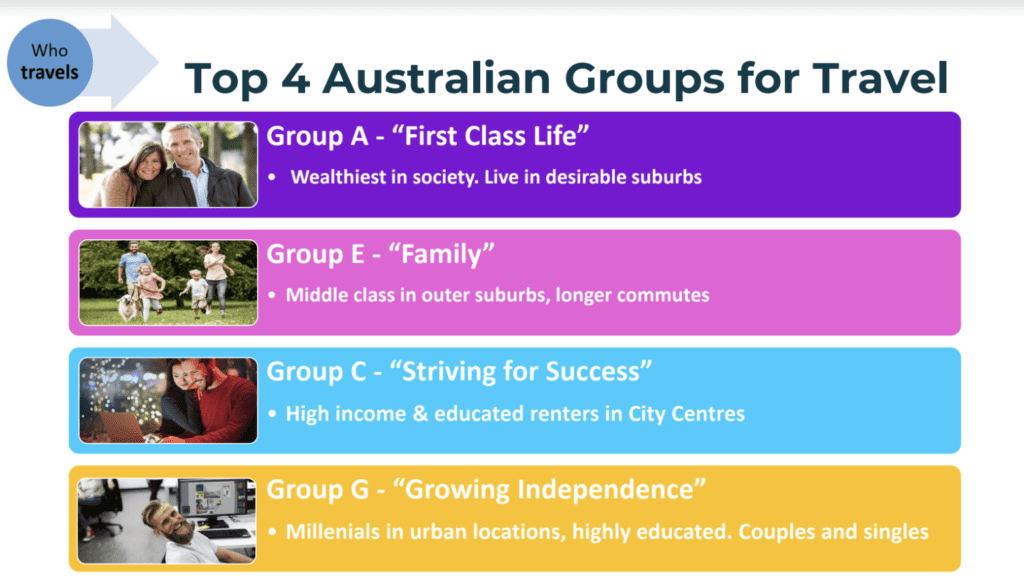
And according to Hewlett’s data: these four groups are 1.3 or 1.5 times more likely to travel between one to four times annually.
It’s estimated that there’s been more change in the Australian population and our demographics in the last four years than there has been in the last several decades, said Hewlett.
“And that change is happening to the people who have the highest propensity to travel.”
And suppliers like Collette, said Hewlett, are more than willing to use their data to help your business.
But how do you use this data in your day-to-day applications?
“What Collette does, is we can go to each postcode and we can see how many houses are in that postcode. We can see how many adults are within that household. And we can say that a Collette customer looks like this. And we can say, ‘Okay, how many Collette customers are there within those groups?
“What that means is that when our Business Development Managers (David Farrar’s team) come to see you, we have that information at our fingertips. If we’re having a conversation with you about growing business, we can bring that science as part of our support.
“You guys have the art of sale. You know your businesses and know your customers. And we can support that with the backing of data to help you to make good marketing choices.”
Hewlett wants agents to leverage their suppliers.
“Through conversations with us, we can help you to grow your business, to grow our business, and for everyone to be successful,” he said.