




Luxury travel is running at roughly double the broader leisure market growth rate, with Virtuoso’s global network recording 20 per cent year-on-year preferred partner sales growth in the first two months of 2026, even as Oxford Economics revised international leisure forecasts lower for the year.
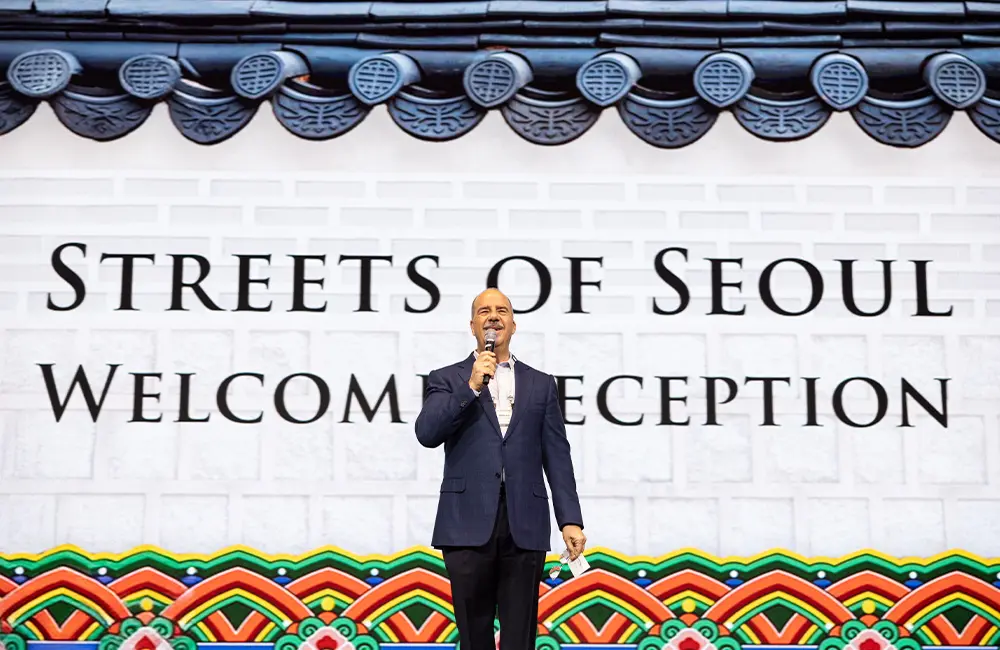
The data was presented at Virtuoso’s 2026 Symposium, held April 15-19 at the Conrad Seoul, which brought together 360 leaders from member agencies and preferred partners across 33 countries.
Oxford Economics data presented by Executive Vice President, Strategic Communications for Virtuoso, David Kolner, showed global international leisure forecasts for 2026 have been revised lower since December 2025, while domestic travel has edged slightly higher.
Both segments are still expected to grow through 2027 and 2028. China is the clear outlier, with international leisure travel revised higher across all three forecast years and overall domestic leisure growth projected at up to three times the global average.
Against that backdrop, Kolner said the Virtuoso network is growing roughly twice as fast as the broader market. March sales growth came in at 14 per cent year-on-year, following the 20 per cent result in January and February.
Forward bookings made one to two years in advance were up 23 per cent in the first quarter of 2026 compared to the same period in 2025, and average daily rates for preferred partners rose between 10 and 12 per cent per month during the quarter.

The US-Israel war on Iran continues to reshape travel patterns, though its full impact on global travel remains unclear and still developing.
Live polling at the Seoul Symposium found 70 per cent of member agencies and 66 per cent of partners reported clients rerouting or choosing alternate destinations, a figure that tracks almost exactly with the 71 per cent rerouting rate Virtuoso’s ANZ Forum in Auckland found in March.
Outright cancellations in Seoul came in at 11 per cent among member agencies and 8 per cent among partners; the Auckland figure was lower still at 7 per cent. Personal safety concerns (66 per cent) and the risk of being stranded (64 per cent) were the primary reasons cited in Seoul for postponing or cancelling trips.
Continental Europe is the leading redirect destination at 59 per cent, followed by North and Southeast Asia at 39 per cent and Latin America and the Caribbean at 35 per cent, which is broadly consistent with what Australian advisors are seeing on the ground.
Virtuoso’s global Owner/Manager Outlook Survey, conducted during regional Forums earlier this year, found 78 per cent of respondents expect sales to increase in 2026, with 41 per cent projecting double-digit growth.

Australia and New Zealand respondents expressed slightly more caution than the global average, while agencies in Greater China led on growth expectations, with 26 per cent anticipating sales increases of 21 to 50 per cent.
Geopolitical conflicts ranked as the top expected disruptor globally, at 88 per cent, ahead of political uncertainty at 75 per cent. Artificial intelligence was viewed more as an opportunity than a threat by Virtuoso members; nearly twice as many respondents held a positive view (35 per cent), led by agencies in Canada and the U.S.
On traveller preferences, discovering new destinations ranked first globally at 72 per cent, well ahead of returning to familiar places at 21 per cent. Immersive and slower-paced travel was selected by 49 per cent overall, rising to more than 60 per cent among respondents in Australia and New Zealand. Price-driven behaviours ranked near the bottom, reinforcing the Virtuoso client’s continued insulation from broader market pressures.
Eighty-one per cent of respondents globally plan to hire in 2026 to meet demand, with 25 per cent of Australia and New Zealand agencies reporting no hiring plans for the year.
KARRYON UNPACKS: The consistency between Seoul’s live polling and Auckland’s in March is notable. Rerouting dominates in both, with ANZ cancellations tracking below even the global rate. That said, the US-Israel war on Iran is still unfolding, and the redirect patterns visible now may not be the final picture. The forward bookings data, up 23 per cent for travel one to two years out, suggests the luxury segment is betting on stability ahead, even if the near-term picture remains in flux.