



Euro summer may be all spritzes, sunsets and soft-launch holiday snaps online, but on the ground it can be brutally hot. And according to a new analysis of 25 European cities, the reason your dream city break can feel like a slow roast may come down to what is missing from the streets themselves: shade.
An Australian researcher has found most buildings across 25 European cities lack the nearby tree canopy needed to provide meaningful cooling during extreme heat.
Dr Thami Croeser, from RMIT University’s Centre for Urban Research, analysed shade levels within 60 metres of 5.5 million buildings across Europe in France, Spain, Italy, Germany, Portugal, Greece and the UK. His analysis found 84 per cent fall below the 30 per cent canopy threshold that urban heat research links to reduced heat island effects.
For Australians heading into a European summer, the analysis offers a concrete way to think about where the heat bites hardest, city by city and even neighbourhood by neighbourhood.
“More than four in five homes and workplaces in the cities we analysed do not have the nearby tree canopy that urban heat research indicates is needed for meaningful cooling,” Croeser said.
“When severe heat hits, a leafy park three blocks away is too far away to help an apartment building surrounded by baking asphalt.”
Which cities fare best and worst
Cologne and Hamburg performed best, with about 45 per cent of buildings above the 30 per cent threshold. Nice followed at 41 per cent, largely thanks to hillside vegetation.
At the other end, Sevilla, a city that regularly faces extreme summer heat, had 98 per cent of buildings below the threshold.
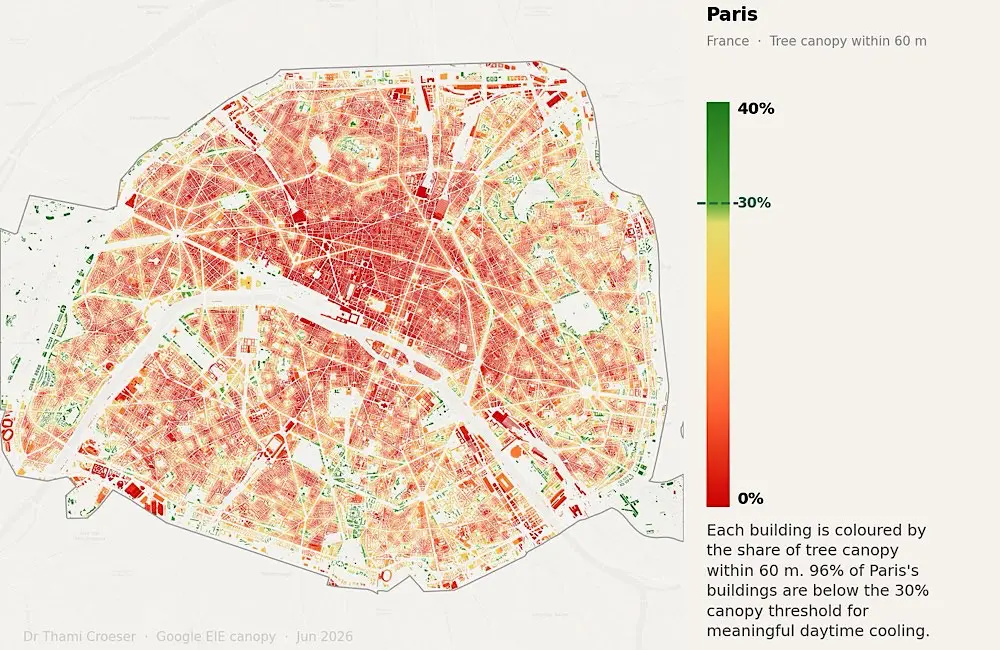
Among the major tourist hubs, London recorded 93 per cent of its 1.5 million buildings below the threshold, Paris 96 per cent (with mean nearby canopy of just 12 per cent), and Rome 85 per cent.
In most cities, more than half of all buildings had less than 10 per cent canopy nearby.
“A city can appear to have a reasonable amount of tree cover overall, while most homes still have very little shade nearby,” Croeser said.
“Tree cooling is highly local. If canopy is not close to where people live and work, it is unlikely to protect them where they are actually experiencing the heat.”
How big is the temperature gap
Comparing neighbourhoods with similar dwelling densities, Croeser found areas with adequate canopy could be 4 to 10 degrees Celsius cooler than comparable urban hotspots. In Paris, the gap reached 10.5 degrees; in Birmingham, 6.6 degrees.
The findings challenge the idea that dense urban areas are inevitably hotter.
“When we compared neighbourhoods with similar dwelling densities, the areas with mature trees were up to 10 degrees cooler than nearby hotspots,” Croeser said.
“We found dense urban areas with apartments, shops, offices and activity centres that stayed much cooler because they had proper shade. The difference is whether trees were protected, planted and given enough space and water to grow.”
The uneven burden
The analysis also found poorer neighbourhoods were consistently more exposed, with lower tree cover and higher surface temperatures in many cities where income or deprivation data was available.
“Heatwaves do not affect all neighbourhoods equally,” Croeser said.
“Lower-income neighbourhoods are often more paved, less shaded and hotter. That means the people with the fewest resources to adapt are often facing the greatest heat burden.”
The work draws on open public datasets and canopy thresholds from established urban heat literature. It has not been peer-reviewed, but Croeser said it provides a timely snapshot of canopy shortfalls across the 25 cities.
KARRYON UNPACKS: With Aussies pouring into Europe each northern summer and heatwaves now a regular feature of the peak season, research like this is a useful reference point when clients ask which cities, and which neighbourhoods, will keep them comfortable. It is also a reminder that where a hotel sits, and what surrounds it, can matter as much as its star rating in July and August.